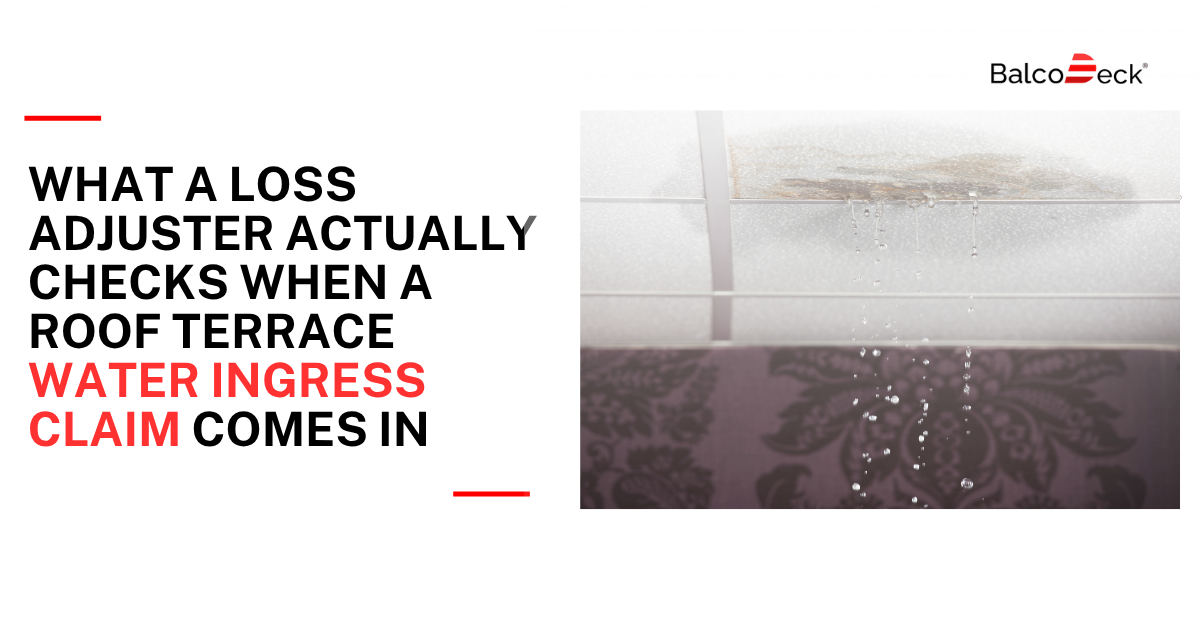
A water ingress claim on a property with a roof terrace follows a different investigation path from most other buildings insurance claims, because the question a loss adjuster has to answer is rarely just whether there is water damage. It is whether the damage originated from the roof itself, from the terrace installed on top of it, or from the junction between the two, and that distinction has a direct bearing on liability, on whether a warranty is engaged, and on how long the claim takes to resolve.
The first question: roof, terrace, or the junction between them
Before a loss adjuster can assess a water ingress claim on a roof terrace property, they need to establish where in the buildup the failure originated. On a standard flat roof with no terrace addition, this is usually a shorter investigation, membrane condition, known age, visible defects. Once a terrace has been added, the investigation has to consider whether the terrace installation itself created or contributed to the failure, which means establishing what was actually done to the membrane at installation, not just what condition it is in now. Where no installation documentation exists, a loss adjuster is often working backwards from the damage to infer what happened years earlier, which is slower and less conclusive than working from a documented installation record forward.
Why penetrative fixings complicate the liability picture
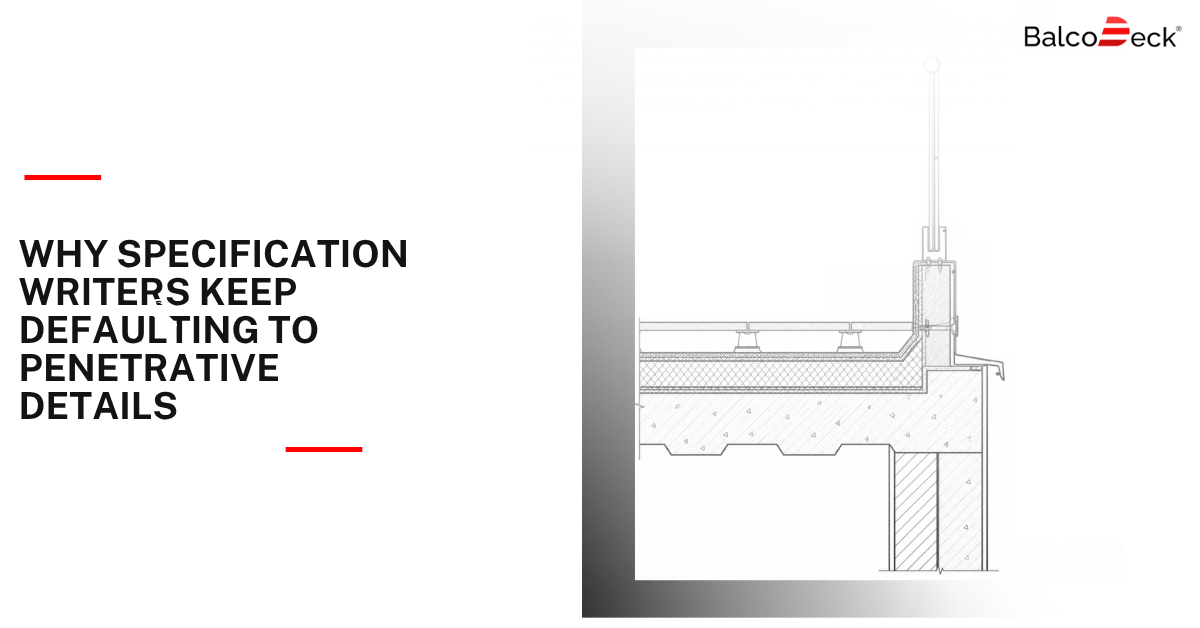
Where a balustrade has been fixed penetratively, through bolts or brackets passing through the membrane, a loss adjuster investigating a leak has to consider the penetrations as a probable point of origin alongside general membrane condition, particularly where the leak is located at or near the terrace perimeter rather than in the open field of the roof. This does not automatically make a penetrative fixing the cause of every claim on a property with one, but a penetration through a waterproofing layer is, in a meaningful proportion of cases, a primary cause of water ingress on roof terraces, because every penetration is a sealed interface that has to remain intact indefinitely, and sealant interfaces are a known area of long-term failure risk. Establishing whether the penetration was made competently, sealed correctly, and inspected since installation is a significant part of the investigation, and that evidence frequently does not exist several years after the work was done.
What documentation shortens the investigation
A Certificate of Compliance issued at installation, confirming the fixing method used and that the system was installed above the finished membrane without penetrating it, gives a loss adjuster a documented starting point rather than an inference. It does not rule out every other possible cause of a leak, membrane age, poor original installation, damage from other trades working on the roof after handover, but it does allow the investigation to rule out the balustrade fixing itself as a probable cause more quickly, which narrows the scope of the assessment considerably. Where no such documentation exists for any installation, penetrative or otherwise, the investigation typically has to rely more heavily on physical inspection, sometimes requiring the terrace to be partially opened up, which extends both the time and the cost of resolving the claim.
What this means for the specification decision at design stage
None of this is a reason to specify a particular product on insurance grounds alone, and a non-penetrative system does not remove the general need for a well-maintained, properly installed and periodically inspected roof buildup. But a specification decision made years before a claim ever arises has a direct, practical effect on how straightforward that claim is to investigate and resolve, and retaining installation documentation, regardless of which fixing method is used, is one of the more overlooked pieces of a project’s handover pack from an insurance perspective.
Key Takeaway
Origin matters more than damage — the first question is whether the failure started in the roof, the terrace, or the junction between them, not just confirming there’s water damage.
Penetrative fixings add scrutiny — any balustrade fixed through the membrane becomes a probable point of origin, especially near the terrace perimeter.
Documentation speeds up the claim — a Certificate of Compliance gives the adjuster a starting point rather than an inference, ruling out the fixing as a cause more quickly.
No records mean more disruption — without installation documentation, adjusters often have to physically open up the terrace, extending both time and cost.
Specification decisions echo years later — a documentation choice made at design stage has a direct, practical effect on how easily a future claim gets resolved.